
The Plutonium Pit
The U.S. Stockpiles 15,000 Plutonium Pits—the core of nuclear weapons, lasting 100 years. Why are we rushing to build more?

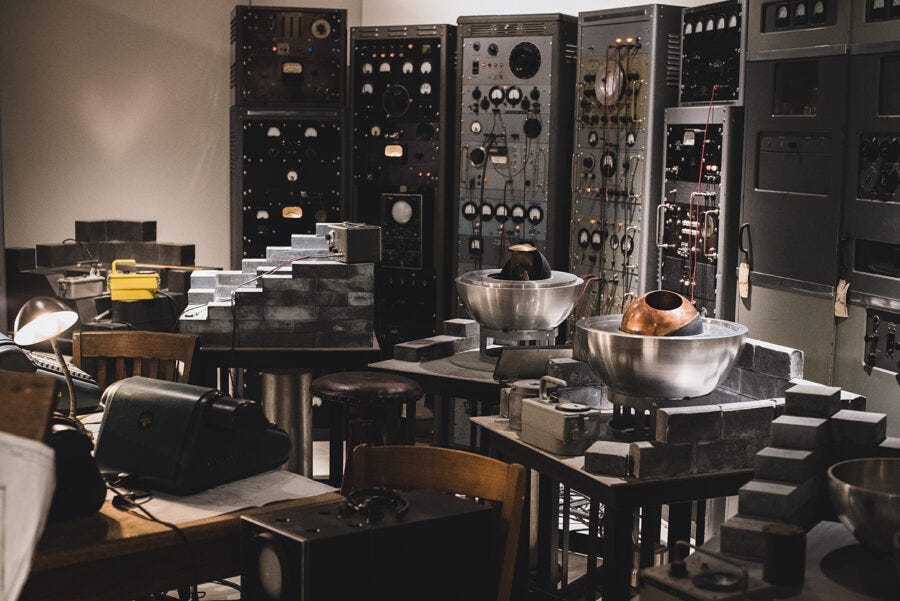
Early this year, the National Nuclear Security Administration (NNSA) and the Department of Energy (DOE) will open a public comment period on their Programmatic Environmental Impact Statement for plutonium pit production. If that sounds Orwellian in its obscurity, you’re right. The bureaucratic language conceals a fundamental question: Does the United States need to renew its production for the first time since 1996 to manufacture more plutonium cores that are at the heart of modern nuclear weapons?
The Demon Core
In August 1945, physicist Harry Daghlian was conducting criticality experiments at Los Alamos Laboratory with a plutonium sphere when the tungsten carbide bricks he was stacking around it slipped. The resulting burst of radiation killed him within weeks. Eight months later, in May 1946, physicist Louis Slotin was demonstrating the same sphere to colleagues when his screwdriver slipped during a similar experiment, causing another supercritical reaction. Slotin died nine days later in agony. After claiming two lives, the six-kilogram plutonium sphere earned its grim nickname: the “demon core.” 1
The term “pit”—referring to the fissile core at the heart of a nuclear weapon—derives from its spherical shape and central position, much like a fruit pit. These pits, produced from weapons-grade plutonium-239 (not uranium-235, which is a separate fissile material), became the focus of intense production during the Cold War. The plutonium was manufactured primarily at the Hanford Site in Washington and later at the Savannah River Site in South Carolina, where uranium was irradiated in reactors and then chemically processed to extract plutonium.2
Today, the United States maintains approximately 15,000 plutonium pits in various stages of the weapons lifecycle, far exceeding the roughly 4,000 deployed warheads in the active stockpile.3 Recent studies by the JASON Defense Advisory Group confirm that pits have minimum lifespans of at least 100 years, with no evidence of plutonium aging that would compromise weapon reliability in the foreseeable future.4 Despite this technical assessment, the Department of Energy and the National Nuclear Security Administration propose producing at least 80 new pits annually by 2030—a goal the Union of Concerned Scientists argues is technically unnecessary, economically wasteful, and strategically destabilizing.5
Any required maintenance of the existing stockpile, including improvements to pit purity or manufacturing precision, can be accomplished at current production levels. More troubling, accelerating pit production risks triggering reciprocal responses from Russia and China, both of which closely monitor US nuclear modernization programs. The proposed expansion comes with an estimated price tag exceeding $20 billion, resources that could address genuine national security priorities rather than manufacturing components we don’t need for weapons we already have. 6
The demon core killed two scientists before its deadly career ended by it being melted down for reuse. The question we face now is whether we will allow its legacy to drive us toward unnecessary renewed production when alternatives such as recycling from the existing stockpile are readily available and would be considerablly less expensive.
The planned production of 80 new pits annually—intended for modernized land-based ICBMs, submarine-launched ballistic missiles, and air-delivered weapons—could be accomplished through pit reuse and remanufacturing from existing stocks.7 We are, after all, a nation that once recognized excess weapons-grade material as a paramount security threat: in the 1990s, the United States purchased 500 metric tons of highly enriched uranium from the dismantled Soviet arsenal and cooperated on plutonium disposition precisely because unsecured fissile material posed unacceptable proliferation risks.8 Now we propose to manufacture more, not because we need it, but because we can—a decision that threatens fiscal responsibility, global stability, and the very nonproliferation principles we once championed.
What’s Actually at Stake
Plutonium pits are the fissile cores of nuclear weapons—the precisely engineered hollow spheres that, when explosively compressed, achieve the critical mass necessary for a nuclear chain reaction. The United States hasn’t produced pits at scale since the Rocky Flats facility in Colorado closed in 1989 following environmental and safety scandals. The NNSA now proposes increasing production to 80 pits annually at two sites: the Savannah River Site in South Carolina and Los Alamos National Laboratory in New Mexico.
The official justification is straightforward: the existing stockpile is aging, and pits must be replaced to maintain its stability. But this framing elides crucial questions. Recent studies, including from the government’s own scientists, assert that plutonium pits will likely remain reliable for a century or more—far longer than the weapons that house them. The Union of Concerned Scientists’ recent report documents how the aggressive production timeline is driven not by verified technical necessity but by ambitious modernization plans that would essentially rebuild the entire nuclear arsenal, though the justification for this is unstated and unclear.
The Environmental and Community Cost
The PEIS must address impacts on communities surrounding production sites, and the history here is sobering. Rocky Flats left a legacy of plutonium contamination, worker exposure, and billions in cleanup costs. Both Los Alamos and Savannah River have troubled histories of radioactive waste, groundwater contamination, and documented health impacts on workers and nearby residents.
The communities bearing these risks are rarely the ones making the decisions. Los Alamos sits upstream from predominantly Hispanic and Native American communities in northern New Mexico who have already endured decades of contamination. Savannah River neighbors some of South Carolina’s poorest counties. This is environmental justice in its starkest form: concentrated risks imposed on vulnerable populations in the name of national security.
Why This Moment Matters
The PEIS process is one of the few mechanisms that allow public input into nuclear weapons decisions, which are typically made behind classification barriers. It’s imperfect—the administration can proceed even over objections—but it creates a public record and forces technical justifications into the open. More importantly, it’s an opportunity for the scientific community to insist that policy claims about “necessity” and “safety” meet basic evidentiary standards.
This matters beyond the immediate question of pit production. We’re watching the infrastructure of nuclear being completely rebuilt with minimal public debate. China is expanding its arsenal; Russia has suspended arms control agreements; and the entire framework of strategic nuclear weapons restraint built over decades is at the point of collapse. The response can’t simply be a massive increase in nuclear weapons capacity—that’s the thinking that gave us 70,000 warheads at the Cold War’s peak. We need informed public engagement about what actual security requires.
The Scientific Community’s Responsibility
Scientists and engineers built this arsenal, and we bear particular responsibility for its consequences. That means not reflexively deferring to security establishments, but asking hard questions: Are these weapons necessary? Are the claimed lifetimes of existing pits accurately assessed? Are environmental and health risks being candidly described? Are there alternative approaches to maintaining deterrence without massive new production infrastructure?
The Union of Concerned Scientists (UCS) is coordinating resources to help the public engage meaningfully with these questions. Their Introduction to Plutonium Pits provides essential technical background. Their radiation and health explainers, developed by public health expert Dr. Chanese Forté, give an accessible grounding in the real impacts of plutonium production. Most importantly, they’re building a network of people committed to informed participation in the 2026 comment period.
What You Can Do
First, educate yourself. The technical details matter—bureaucracies count on public eyes glazing over at terms like “plutonium pit production capacity.” Don’t let complexity become a shield against scrutiny.
Second, sign UCS’s comment pledge. This signals your intent to participate in the formal comment period and helps build the visible public engagement that can’t be dismissed as routine.
Third, share these resources in your networks. Most people are unaware that this decision is coming, yet its implications affect everyone. Nuclear weapons policy shouldn’t be made in technocratic isolation.
Finally, prepare substantive comments for 2026. Generic objections carry little weight; specific technical, environmental, or policy questions force serious responses. I’ll be using this space to explore aspects of the pit production program in detail as the comment period approaches.
The infrastructure we build now—both physical and political—will constrain choices for decades. That makes 2026 not just another bureaucratic milestone, but a genuine decision point about what kind of nuclear future we’re choosing. The scientific community helped create these weapons. We owe it to everyone living with the consequences to help ensure their management meets the highest standards of technical honesty and public accountability.
© 2025 Farooq Hussain
“Critical Assembly, the Secrets of Los Alamos 1944: An Installation by American Sculptor Jim Sanborn,” is now on permanent display at the National Museum of Nuclear Science & History, Albuquerque, New Mexico. Sanborn is best known for the encrypted “Kryptos” sculpture at CIA headquarters in Langley, Virginia, which invites visitors to explore and study the artist’s rendition of the super-secret experiments from the Manhattan Project’s atomic bomb program.
Wellerstein, Alex. Restricted Data: The History of Nuclear Secrecy in the United States. University of Chicago Press, 2021, pp. 45-67.
(Makhijani and Saleska 112-145). Makhijani, Arjun, and Scott Saleska. The Nuclear Power Deception: US Nuclear Mythology from Electricity “Too Cheap to Meter” to “Inherently Safe” Reactors. Apex Press, 1999, pp. 112-145.
Kristensen, Hans M., and Matt Korda. “United States Nuclear Weapons, 2023.” Bulletin of the Atomic Scientists, vol. 79, no. 4, 2023, pp. 234-254.
JASON Defense Advisory Group. Pit Lifetime. JSR-06-335, 2006, pp. 3-8.
Gronlund, Lisbeth, and Stephen Young. “Excess Plutonium Pit Production: Unnecessary and Destabilizing.” Union of Concerned Scientists, 2023, pp. 12-15. The Department of Energy’s National Nuclear Security Administration (DOE/NNSA) published a Notice of Intent (NOI) in the Federal Register on May 9, 2025 to prepare a Programmatic Environmental Impact Statement (PEIS) for plutonium pit production.
Spaulding, Dylan, New Plutonium Pits for Nuclear Weapons are Not Needed, Union of Concerned Scientists, June 12, 2025
Government Accountability Office. Nuclear Weapons: NNSA’s Plutonium Pit Production Plans Are Not Supported by Adequate Cost and Schedule Information. GAO-21-174, 2021.
The National Nuclear Security Administration’s own assessments acknowledge that pit reuse is technically feasible for maintaining the stockpile. The JASON studies confirmed that existing pits retain their reliability well beyond original design assumptions, making wholesale replacement unnecessary. See 4 above. Yet the proposed Los Alamos and Savannah River production facilities are sized for new manufacturing, not remanufacturing—a choice driven by institutional momentum rather than strategic necessity. For detailed technical analysis of pit reuse options, see Gronlund et al., “Plutonium Pit Production: An Alternative Approach” See 6 above. The National Nuclear Security Administration’s own assessments acknowledge that pit reuse is technically feasible for maintaining the stockpile. The JASON studies confirmed that existing pits retain their reliability well beyond original design assumptions, making wholesale replacement unnecessary. Yet the proposed Los Alamos and Savannah River production facilities are sized for new manufacturing, not remanufacturing—a choice driven by institutional momentum rather than strategic necessity. For detailed technical analysis of pit reuse options, see Gronlund et al., “Plutonium Pit Production: An Alternative Approach.”
Bunn, Matthew, and Anthony Wier. “Securing the Bomb 2007.” Project on Managing the Atom, Harvard University, 2007, pp. 145-158.